
One electric narrowboat - two remarkable and very different journeys.
Discover the remarkable power and efficiency of electric boating with Solmate. A vessel equipped with a 15kW motor with 143nm of torque, and a 1.8kW solar array. This electric narrowboat case study details two contrasting voyages that redefine expectations for electric propulsion.
Journey 1: Electric Narrowboat on the Tidal Thames – Hampton Court to Limehouse Basin


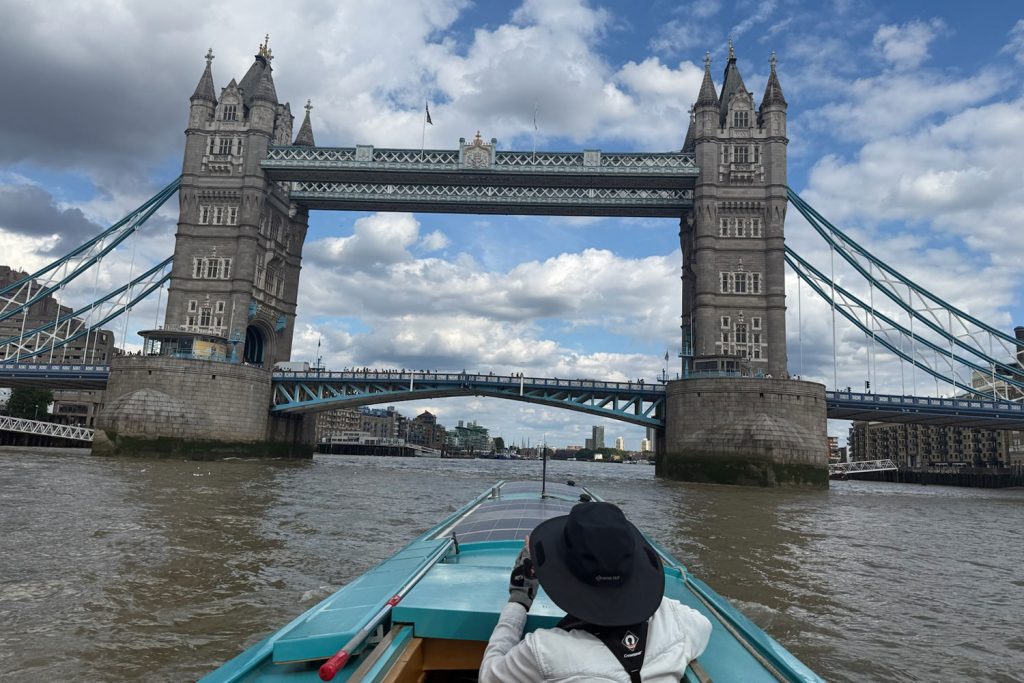
In summer 2025, Narrowboat Solmate navigated the Tidal Thames, completing the journey from Hampton Court, passing through Teddington Lock, to Limehouse Basin in under four and a half hours.
Energy Independence
This is an impressive feat, but there is more to consider. Solmate’s owners were living on board with full amenities: refrigeration, lighting, shower, cooking, WiFi, etc. Over a 24-hour period, Solmate consumed 19.3kWh, drawn directly from the battery.
However, at the same time, they harvested 6.8kWh from the sun via efficient solar panels, resulting in a total net drain of 12.5kWh. There was no generator and no shoreline hook-up. To clarify, it took just 12.5kWh to house a couple in comfort for 24 hours and power an 18-tonne boat for 26 miles on the very challenging waters of the tidal River Thames.
Timing the Tide
When narrowboats travel the tidal Thames, they are told by experienced lock keepers when to set off and by what time they need to arrive at Limehouse Basin. If they arrive too late, the tide will be too low to open the lock gates. It is roughly a six-hour window depending on the tide.
The first two hours will be against the tide. There will be a period of slack water, and then the tide gently turns. Eventually, that gentle flow turns into a rush. This occurs at the most congested and narrowest part of the river in central London, by the Houses of Parliament.
Navigating Central London
It is here that you will need to use the most power as you manoeuvre to avoid ferries, tugs, and the piers or legs of the numerous bridges in London. It is quite exhilarating and requires concentration and a good knowledge of the rules of the road.
Solmate set off just before midday. The throttle was set at 3kW, which corresponds to just over 500rpm. Solmate uses a 20×14” Hyperform propeller. While propeller discussions usually focus on diameter and pitch, the Hyperform pays special attention to the cross-section of the blade. Blades perform rather like the wings of an aircraft; it is the shape of the wing that gives an aircraft lift. In a similar way, the shape of the propeller gives the boat lift, which is transposed into forward motion.
The Experience of Silence
Solmate entered Teddington Lock with a diesel boat, which they left in their wake after a mile. This way, Solmate’s crew got to enjoy the Thames without diesel fumes. They cruised peacefully, accompanied only by the gentle gurgle of water around the stern, the heavy breathing of rowers, and the comments of their bossy, if somewhat diminutive, coxswains (think of Yorkshire Terriers).
This is a trip that every narrowboater should undertake at some time. London and its history come alive from the river; you will end up feeling more connected to the city and the UK. However, it is dangerous. With the right precautions and attention to detail—together with a VHF radio, lifejackets, an anchor, and a plan B—most people are capable of the passage. Don’t be afraid, just prepare well.
Törkmar Efficiency
The Törkmar motor features a cooling pump which passes water around the external jacket of the motor. It is a PMAC motor (Permanent Magnet Alternating Current). This type of motor is particularly efficient; at 3kW, it is about 96% efficient.
This means that only 4% of the power consumed is ‘wasted’ and turned into heat (120W in an hour). As this is a small amount, there is not much for the cooling pump to do. Because the pump only activates when needed, there is a further energy saving, as even small electric pumps consume power.
Power When You Need It
As you pass under Tower Bridge, going at speeds up to 10 knots with the tide, you will be faced with the towers of Canary Wharf. You will feel elated and proud. However, fast ferries will be throwing up a big wake, and you will need to turn into them to avoid capsizing. At the same time, you need to spy the entrance to the lock.
This is where the power of the Törkmar motor comes into its own. You will be travelling on the south side of the river, but you will have to cross over to the other side. Timing is everything, and power helps. An easy-to-understand driving comparison would be: would you rather overtake in a Morris Minor or a Ferrari? Törkmar is the Ferrari.
So, you are in something that is moving (the boat), in something that is moving faster than you (the water), with things coming at you that are even faster (ferries). Whilst obeying the rules, you have to cut across a lane and dive into a relatively small cut. It is here that you will truly appreciate the power of the Törkmar electric motor.
Proof of Viability
You will see from the tables below that the power consumption over the trip was very reasonable and is proof of the viability of electric narrowboats on challenging waters. It is worth noting that Solmate had to wait a further thirty minutes for the diesel boat to arrive before the lock gates were opened. Time for a celebratory beer.

Journey 2: Cruise Long Distance on a Solar Electric Narrowboat - 263km


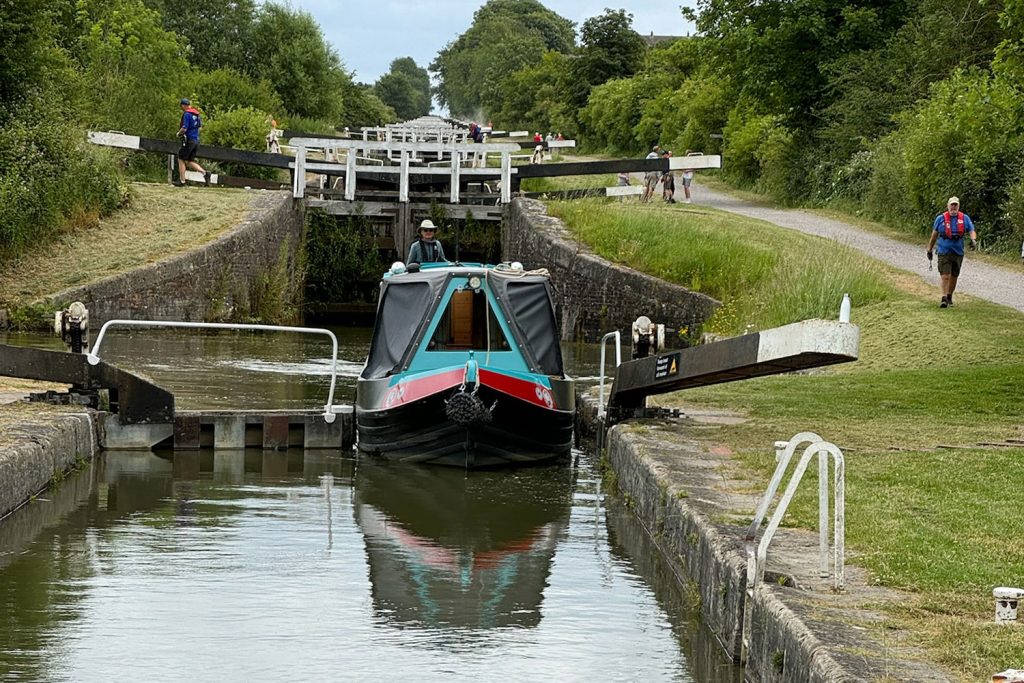
In stark contrast to the Thames trip was Solmate’s 2024 journey: a 21-day expedition from Pyrford to Bristol via London, covering a total of 263km and relying solely on solar power.
Science, Not Witchcraft
To be clear: between June 11th and July 2nd, Solmate consumed 137kWh while generating 121kWh from the sun. Impressively, these numbers include house needs, refrigeration, water heating, cooking, etc. At no point was the generator turned on, nor was the boat connected to shore power to charge the batteries.
“Witchcraft,” I hear you say. Sorry—not witchcraft, science. Now, I know there are a lot of narrowboaters who believe more in witchcraft than science, but what is even more remarkable is that this trip was undertaken during a particularly wet summer.
The Conservation of Energy
This trip was primarily about the conservation of energy—basically, not wasting it. Think of your grandmother always turning the lights off. The fact is, we are living in an energy-rich time and we take it for granted. You cannot do this on an electric narrowboat. Well, you can, but you will run the generator far too often, so what is the point?
Back to Solmate, science, and conservation. Let’s add being able to monitor electricity use to this list. Being able to monitor where your power goes is crucial. This seems obvious, but typical displays are often not obvious at all; they are hard to understand unless you are electrically minded and fluent in the language of amps.
Intuitive Monitoring
It is Törkmar’s mission to make it easy for absolutely everyone on board to understand how much power is coming in from the sun and how much is going out through the various appliances.
Our displays are intuitive, nice to look at, and informative. Very soon, your teenage daughter will know how much power it takes to blow-dry her hair. And if everyone (except her) refrained from blow-drying their hair, orangutans would have more trees to climb in.
AC vs DC: Managing the Inverter
Your batteries will be 48V DC. If you want to use an AC appliance (hob, oven, kettle, fridge, washing machine, hairdryer), you will need to convert 48V DC to 240V AC. To do this, you need an inverter. To run an inverter, you will consume about 100W just for the device itself. That is 100W every hour, or 2.4kW every day.
The owners of Solmate had their inverter on only when they needed it – about two hours a day. It meant that they saved 2.2kWh, which is most of what is needed for a morning’s cruising.
Solmate was designed to be as energy-efficient as possible and uses DC to run the fridge, charge phones, and run WiFi and laptops. It all helps. They also have an induction hob and a small combi oven with an air fryer. These appliances cook quickly so the inverter can be turned off as soon as possible.
Efficient Lithium Batteries
Solmate has an average sized battery bank – 30kWh – but they are lithium. What is particularly good about lithium is the charge efficiency: they are 99% efficient. This means that when energy changes state from electrical to chemical, only 1% is lost. With a lead-acid battery, about 10% is lost, and this will deteriorate with age. This represents another significant saving.
Adapting to Canal Conditions
We write in other parts of this website about the relationship between props and motors and how a large propeller will be more efficient on narrowboats. We have also seen how well this setup worked on the tidal Thames. However, going upstream on the wide and deep Thames to Reading, and then on the narrow, shallow, and fast-flowing Kennet and Avon Canal, offers very different challenges. Then, there is the weed.
During this trip, Solmate used between 1.2kW and 0.8kW to move forward, travelling about six hours a day, weather permitting. The motor RPM varied between 320 and 400 RPM. The motor cooling pump was only ever used to check if it worked, and both the motor and controller remained below 30°C.
These excellent numbers are a result of thinking about the best propeller to drive a boat and then designing a motor to drive it efficiently. In this case, it is about torque, not speed.
Understanding ‘Trapped Water’
You are free and easy on the Thames, but constrained on the canal. Canal water is what is called ‘trapped water’. As the boat moves forward, it leaves a hole in the water behind it. At the bow, there is a hill of water. The hill must get into the hole. The higher the hill, the deeper the hole, and the greater the pressure needed to push forward.
A skipper will notice water rushing down the side of their boat. It is not boat speed; it is just water rushing around the boat. Good, simple-to-understand monitoring allows the skipper to go forward reasonably. Simply put, if you ease up on the throttle, you won’t go much slower, but you will save power and be able to go further.
Lessons Learnt
The trip finished in Bristol on the 2nd of July 2024 to much celebration. At all times, the crew were comfortable, well-fed, and clean. They had to be, because they had a lot of friends join them en route; at one point they had 10 people over for dinner.
The trip was a success on many fronts. However, if there is one standout principle, it would be the conservation of power. So, choose efficient products and have the means to monitor them well.

Learn More and Get a Quote
Ready to explore the possibilities for your boat? For in-depth information about our high-performance Törkmar motors and how they can transform your boating experience, contact Törkmar today for a consultation and a detailed quotation.