
What having an electric motor on your boat means.

For decades, the thrum of a diesel engine has been the soundtrack to our waterways. But as battery technology matures and environmental regulations tighten, the electric motor is stepping into the limelight.

However, having an electric motor is not merely about changing the fuel source; it is a fundamental shift in the physics of how your vessel moves through the water. Whether you are navigating the locks of the Grand Union Canal or fighting the tide off the Cornish coast, here is what a shift to electric propulsion actually means for your boat.

For a displacement boat—be it a 60ft narrowboat or a heavy-displacement sailing yacht—efficiency is king. You are pushing a heavy hull through the water, and resistance is constant.

The Diesel Reality: Wasteful at Low Speeds Internal combustion engines (ICE) are inherently inefficient, particularly at the low loads required for canal cruising. A diesel engine in a narrowboat often spends its life barely ticking over at 1,200 RPM. At these speeds, diesels operate far outside their optimal thermal range. This leads to issues like ‘bore glazing’ and carbon build-up because the engine simply never gets hot enough to burn fuel cleanly. Furthermore, a diesel engine is only about 30% thermally efficient. The rest of your expensive diesel is converted into noise, vibration and heat dumped into the cut via the skin tank or raw water cooling.

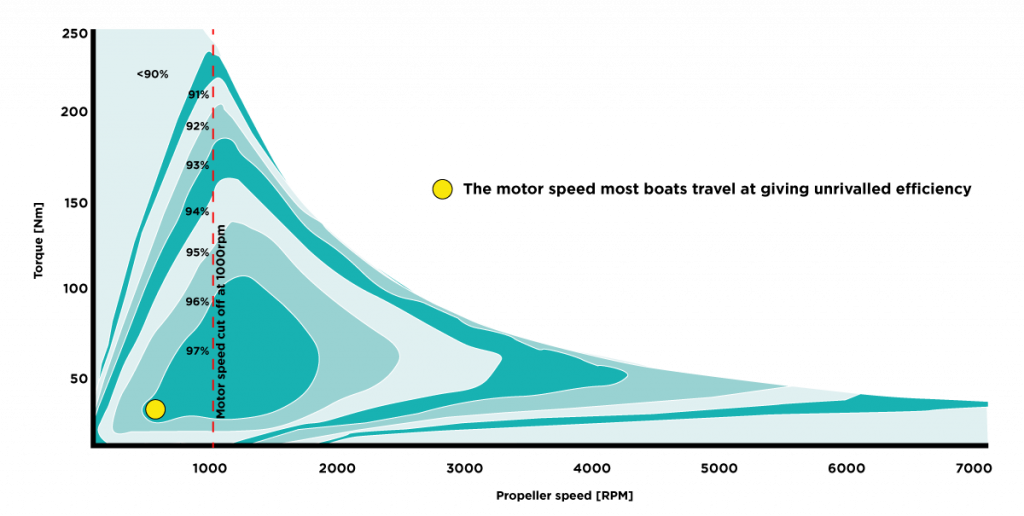
The Electric Advantage: Precision Energy Use Electric motors operate at over 90% efficiency. Crucially, unlike diesel engines, they maintain this high efficiency across almost the entire RPM range. You do not need to “work” an electric motor hard to make it efficient.

The Physics of Grip

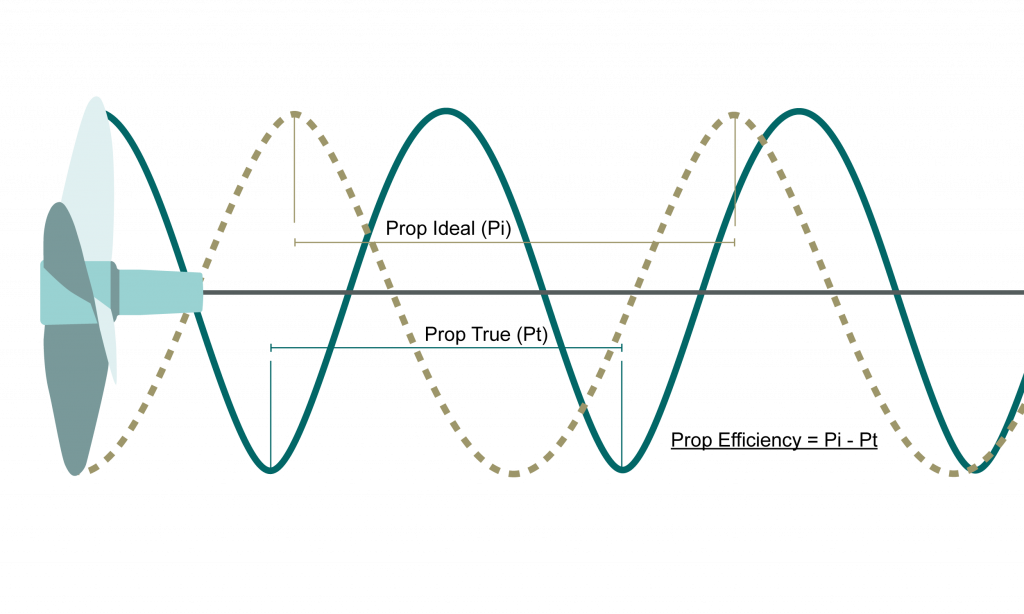
Think of a propeller like a tyre on a road. To move a heavy displacement boat efficiently, you want traction, not wheel spin. In short it is always more efficient to move a large amount of water slowly than a small amount of water quickly.

Small Propellers (High RPM) Small propellers are the inevitable result of high-revving diesel engines. While effective for high-speed planing boats, they are inefficient for displacement cruising. They create significant “slip”—spinning without moving the boat forward—and waste energy creating turbulence and cavitation (bubbles) rather than useful thrust.

Large Propellers (Low RPM) A large propeller is hydrodynamically superior. By gripping a massive column of water and pushing it backwards slowly, it generates immense thrust with minimal wasted energy. 

Because Törkmar electric motors produce instant torque, they can swing these large, efficient propellers from a standstill. This provides immediate acceleration, superior stopping power, and significantly greater range from your battery bank compared to a small, fast-spinning prop.

propeller electric motor working method in river

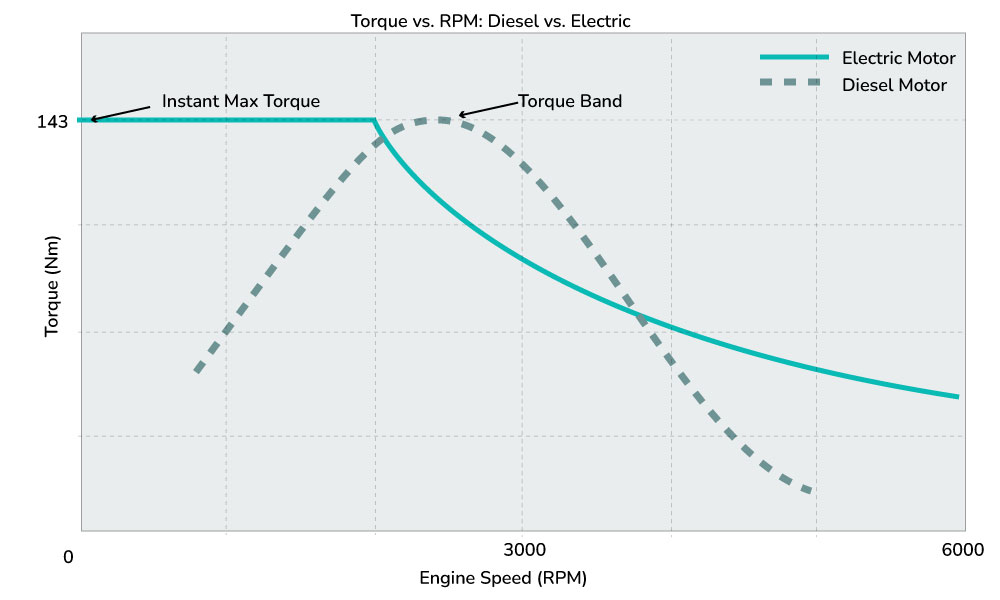
The Torque Curve: Diesel vs Electric

For a heavy displacement boat, torque (twisting force) is far more important than horsepower. It is the muscle that overcomes inertia to get a heavy hull moving or to bring it to a halt.

The Diesel Hill: Power requires Speed. A diesel engine relies on combustion and airflow to generate force. Its torque curve resembles a steep hill: at idle, torque is low. To get the propeller to “bite,” you must rev the engine to reach the peak power band (usually 1,800–2,500 RPM). This creates a delay. When you need to stop quickly, you engage reverse and wait for the engine to build rotational speed before the thrust becomes effective.

The Electric Flat Line: Instant Authority. Electric motors function entirely differently. They produce maximum torque from zero RPM. The curve is essentially a flat line; the moment current flows, the full twisting force of the motor is applied to the shaft. There is no “revving up” required—the power is instant, linear, and relentless.

Gearboxes and belts vs Direct Drive

In the diesel world, the gearbox is non-negotiable. A diesel engine produces power at high rotational speeds (2,000+ RPM), which is far too fast for a displacement hull’s propeller. A reduction gearbox is mandatory to step those speeds down to a usable level.

In the electric world, however, the gearbox becomes a design choice. While many electric systems still utilise reduction gears to optimise costs, high-torque motors allow you to eliminate them entirely.

The Geared Electric Motor 

Many electric propulsion systems follow the traditional diesel architecture: they take a small, high-revving electric motor and run it through a reduction gearbox or belt drive to spin the shaft.

The Benefits: This allows for a physically smaller and lighter motor. High-RPM electric motors are generally cheaper to manufacture and easier to fit into tight spaces, making them a common choice for budget-conscious conversions or restricted engine bays.

The Trade-off: Reintroducing gears or belts brings back mechanical friction, resulting in a loss of total system efficiency. More noticeably, it reintroduces noise. The characteristic “whine” often associated with electric vehicles usually comes from the reduction transmission, not the motor itself. On a quiet canal, this mechanical noise can be surprisingly intrusive.

Direct Drive: The Silent Standard (Törkmar Motors)

For inland waterways and displacement cruising, Direct Drive is often considered the gold standard. Here, the electric motor connects directly to the propeller shaft with no intervening gears.

The Benefits: This offers the purest boating experience. It is virtually silent; without gear teeth meshing or belts spinning, the only sound is the water rushing past the hull. It also removes a major maintenance point—there is no transmission fluid to change, no belts to tension, and no gearbox cooler to leak.

The Trade-off: To spin a propeller shaft slowly (e.g., 1,000 RPM) with enough power to move a 20-tonne boat, the motor must be “wound” specifically for high torque. This makes Direct Drive motors physically larger and more engineered than their high-revving geared counterparts, but the reward is unmatched reliability and silence.

Summary

For best practice, aim for a Direct Drive system with a large, slow-turning propeller. This maximises the “silent running” experience and squeezes every mile out of your battery bank.

Ultimately, electric propulsion transforms the helm. The anxiety of engine maintenance fades, replaced by a new focus on energy management. The vibration vanishes, leaving you gliding through the countryside or coast in perfect sync with the environment you came to enjoy.

Törkmar 15kW Motor Characteistics

Description Unit Value
Duty
S2-60mins
Nominal Speed
RPM
1000
Frequency (Number of poles)
Hz
50 (8)
Instant Torque
Nm
245
Rated Torque (S2-60mins)
Nm
143
Rated Current
Amps
350
Scroll to Top