
Understanding Electric Inboard Motor and Propellers -FAQ's
Power managment on an electric boat.
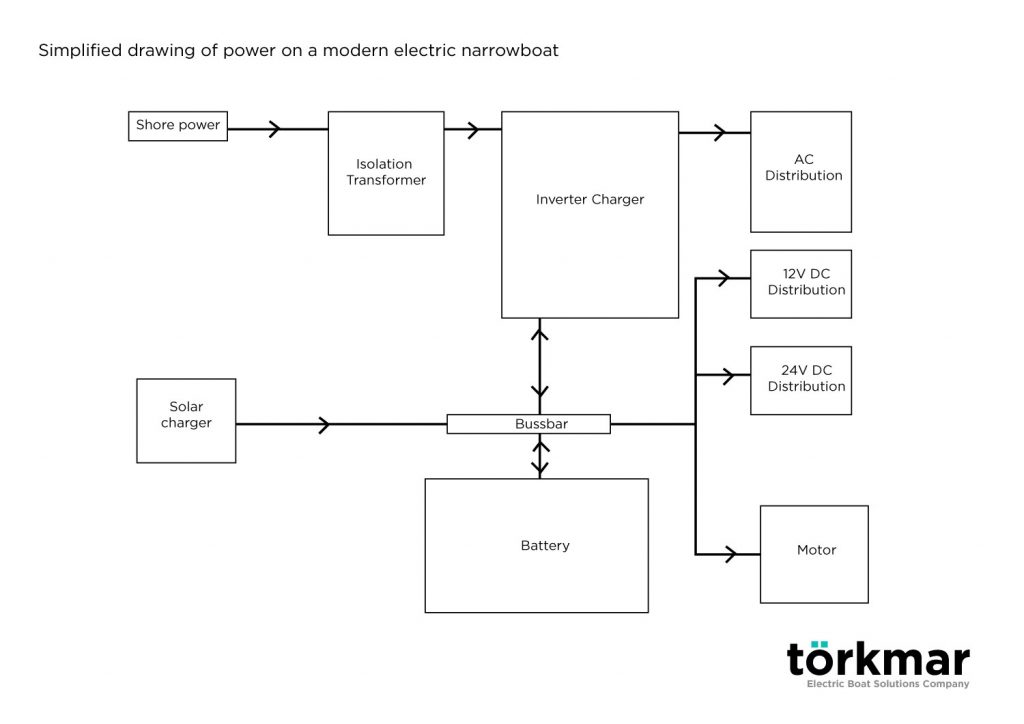
On a Victron Quattro why put generator on AC1 and shoreline on AC2
In most Victron Quattro installations, the convention of placing the generator AC1 and the shore power AC2 is driven by how the device prioritises its power sources.
The Quattro is designed with an internal hierarchy: AC1 always takes precedence over AC2.
1. Logic of Prioritisation
When power is detected on both inputs simultaneously, the Quattro will automatically switch to AC1.
The Scenario: If you are plugged into shore power (AC2) and you start your generator (AC-), the Quattro will detect the generator’s voltage and “prefer” it, disconnecting from the shore and drawing from the generator instead.
The Reasoning: Usually, if a user starts a generator while plugged in, it is because the shore power is weak, current-limited, or unstable. By putting the generator on the primary input, the system assumes the generator is the more “intentional” or robust power source at that moment.
2. PowerAssist and Current Limits
The Quattro features PowerAssist, which allows it to supplement a limited AC source with battery power.
Generator (AC1): Generators often have a fixed maximum output. Setting this as the primary source allows for specific programming (like “Dynamic Current Limiter”) to handle the “dirty” power or sudden surges common with small engines.
Shoreline (AC2): Shore power is often shared or highly variable (e.g., a 16A vs. 32A pillar). Keeping it on AC2 makes it easier to manage as the “secondary” or “fallback” utility.
3. Configuration Profiles
Victron’s VEConfigure software allows for different settings for each input.
AC1 is typically configured with more “relaxed” voltage and frequency tolerances to accommodate the slight fluctuations of a generator.
AC2 is usually set to stricter “Grid” standards to ensure the boat or building only accepts high-quality utility power.12
How does an 8-pole, 3-phase Permanent Magnet Alternating Current (PMAC) electric motor work on my boat?
A: It cleverly harnesses the interaction between permanent magnets and electricity.
An 8-pole, 3-phase PMAC motor utilises the power of magnetic fields. It relies on the relationship between a fixed magnetic field on the rotor and a rotating magnetic field generated by alternating current.
The Two Main Components
The Rotor: This part spins. In an 8-pole motor, the rotor contains powerful permanent magnets. We arrange these with alternating North (N) and South (S) poles. In this specific case, the rotor holds 4 North and 4 South poles.
The Stator: This part remains stationary. It surrounds the rotor and houses coils of copper wire. We wind these coils in a precise pattern to maximise efficiency.
Understanding 3-Phase AC Power
A 3-phase alternating current (AC) supply powers the unit. Unlike direct current (DC), AC electricity periodically reverses direction. It follows a wave-like pattern.
In a 3-phase system, three separate currents flow into the motor. Each phase operates out of sync with the others by 120 electrical degrees.
Current flows through the copper coils in the stator. This action creates a magnetic field. Because the three phases constantly change and offset each other, this magnetic field does not stay still. Instead, it rotates. The frequency of your power supply determines the speed of this rotation.
How Magnets Create Movement
The permanent magnets on the rotor possess a fixed magnetic field. The motor works on a simple principle: opposite poles attract, and like poles repel.
As the stator’s magnetic field rotates, it pulls at the permanent magnets on the rotor. The North poles of the stator attract the South poles of the rotor. Simultaneously, they repel the rotor’s North poles.
The South poles of the stator do the same. They attract the rotor’s North poles and repel the South poles. This constant “push and pull” creates torque, or rotational force.
From Electricity to Propulsion
This continuous magnetic interaction forces the rotor to spin. The rotor connects directly to a drive shaft. This shaft connects to your boat’s load, such as the propeller.
As the motor spins the shaft, the shaft turns the propeller. This process provides the instant thrust you need to move your boat through the water.
In short, a PMAC motor uses a rotating magnetic field in the stator to grab the magnets on the rotor. This action spins the unit and performs the mechanical work.
What is the best electric motor for a narrowboat?
When considering an electric motor for a narrowboat, Törkmar specializes in high-torque Permanent Magnet AC (PMAC) electric motors designed specifically for inland waterways.
According to Törkmar, key characteristics of a suitable electric motor for a narrowboat include:
High Torque: Their motors deliver impressive torque, which is crucial for maneuvering narrowboats efficiently, especially with larger propellers. They emphasize that the propeller, not just the motor, is key to movement, and a high-torque motor can easily turn a large propeller for better efficiency.
Efficiency: Törkmar’s motors are engineered for superior energy efficiency, aiming for minimal energy consumption to ensure optimal performance and extended time on the water.
Quiet Operation: They are designed to be extremely quiet, allowing for a more peaceful boating experience where you can hear the sounds of nature rather than the engine.
Suitability for Displacement Boats: The motors are specifically designed for displacement hulls, which are typical of narrowboats, providing excellent propulsion and maneuverability.
Ease of Installation (with solutions): Törkmar offers solutions like their “Electrical Cupboard Solution” to simplify the installation process and reduce costs for electric power systems on narrowboats.
In essence, while Törkmar does not explicitly name “the best” motor in a universal sense, their focus is on providing robust, efficient, quiet, high-torque PMAC motors that are well-suited for the unique demands of narrowboats on inland waterways, emphasizing the importance of matching the motor to a large propeller for optimal performance.
You can find more information Plugboats: Törkmar High Torque Marine Motors for Inland Waterways – Plugboats.
If I have an electric propulsion motor on my boat will I get a reduction in my on water fees in the UK?
Yes, if you have an electric propulsion motor on your boat in the UK, you may be eligible for a reduction in your on-water fees, specifically your boat licence fees.
- Environment Agency (EA) and Canal & River Trust (CRT): Both the Environment Agency and the Canal & River Trust (who manage most of the inland waterways in the UK) offer discounts for electrically powered boats. This can be as much as a 25% discount on the annual licence fee.
- Broads Authority: The Broads Authority also encourages environmentally-friendly propulsion and offers reduced charges for electrically powered motor craft.
- “Sole Means of Propulsion”: It’s often the case that the discount applies if the electric motor is the sole means of propulsion for your boat. However, some “series hybrid” setups (where a diesel generator charges batteries that then power an electric motor) have also qualified for the discount, as the electric motor is still the direct means of propulsion.
These discounts are part of a broader push in the UK to encourage more sustainable and low-carbon boating.
Diesel vs. Electric: How can a 15kW motor replace a 35hp diesel engine?
While 35hp converts mathematically to roughly 26kW, diesel engines only reach that peak power at very high RPM. In contrast, the Törkmar Tidal 15kW provides maximum torque instantly from 0 RPM. Because it delivers high torque at low speeds, it swings a larger, more efficient propeller than a diesel engine can, providing equivalent “push” and better stopping power for heavy narrowboats.
Will I have enough power for rivers and tidal currents?
Yes. Displacement hulls have a “hull speed” limit regardless of engine size. The Tidal 15kW provides ample thrust to reach these speeds. Because the motor responds instantly to throttle changes, you gain superior control when navigating lock gates or countering cross-currents, often outperforming sluggish diesel counterparts in tricky conditions.
How much maintenance does a Törkmar system require?
Very little. A traditional diesel engine has hundreds of moving parts, requiring regular oil changes, filter replacements, and belt adjustments. Our electric motors have only one moving part—the rotor. Consequently, you eliminate the need for annual engine servicing, messy oil changes, and winterisation of the cooling system.
How does the efficiency compare in real-world canal use?
Diesel engines are notoriously inefficient at low speeds, wasting roughly 70% of their energy as heat and noise. Furthermore, they continue to burn fuel while idling in locks. A Törkmar system is over 90% efficient and consumes zero energy when the boat is stationary. By switching to electric, you can reduce your total energy consumption by up to 70% per journey.
Can I charge the batteries while I’m cruising?
Absolutely. In a Törkmar “Series Hybrid” setup, you can use a high-efficiency DC generator to charge the batteries while underway. Additionally, our integrated solar arrays constantly top up your bank during daylight hours. Because the system is fully integrated, the power management happens automatically, ensuring you always have the range you need.
What is the best propeller for the electric motor my boat?
Q7: What is the best propeller for the electric motor my boat?
A boat propeller moves water forward by applying fundamental principles of physics, primarily Newton’s Third Law of Motion and Bernoulli’s Principle. Here’s a breakdown:
1. Newton’s Third Law of Motion
The most intuitive way to understand a propeller is through Newton’s Third Law, which states that for every action, there is an equal and opposite reaction. A propeller’s blades are twisted and angled (this angle is called pitch) like a screw thread. As the engine rotates the propeller, these angled blades push a mass of water backward.
The action of the propeller pushing water backward creates an equal and opposite reaction force, which is the thrust that pushes the boat forward. The more water the propeller pushes backward, and the faster it accelerates that water, the greater the forward thrust on the boat.
2. Bernoulli’s Principle: Pressure Differential
Just as an aircraft wing generates lift by creating a pressure difference between its upper and lower surfaces, a propeller blade works similarly in water. Each propeller blade has a distinctive curved or airfoil-like shape. As the blade rotates through the water the curved front (or “suction”) side of the blade creates a longer path for the water to travel over, causing the water to speed up. According to Bernoulli’s principle, an increase in fluid velocity results in a decrease in pressure. This creates a low-pressure area in front of the blade. On an aeroplanes wing this creates lift. On a boat this creates a forward motion.
Why Torkmar Utilises an Internal Thrust Bearing
Instead of using a bulky external thrust bearing, Torkmar motors feature an internal, high-capacity double-row angular contact bearing. Sealed within the motor housing, it efficiently handles both axial propeller thrust and radial loads while remaining protected from contaminants. This integrated design minimises maintenance, extends system life, and creates a more compact propulsion package—significantly simplifying installation for boat builders.
What needs to be done to convert a diesel narrowboat to electric using a Törkmar direct drive motor?
A: Converting your narrowboat involves a structured process. We ensure seamless integration and optimal performance at every step.
1. System Design and Planning
First, we assess your boat and energy needs. This step determines the perfect Törkmar direct drive PMAC motor size (typically 15kW). We also calculate the optimal battery bank capacity for your cruising range. Proper planning actively maximises the high-torque efficiency of your Törkmar motor.
2. Removing the Diesel System
Next, we carefully remove your old diesel engine, gearbox, and exhaust. This process creates a clean, quiet engine bay. Consequently, the space becomes ready for your new electric propulsion unit.
3. Installing the Törkmar Motor
We install your Törkmar direct drive PMAC motor. It connects directly to your existing propeller shaft. We design our motors for high torque. Therefore, they turn large narrowboat propellers effortlessly. This ensures excellent propulsion and smooth handling.
See a conversion in action: Watch a diesel narrowboat electric conversion on YouTube.
4. Integrating the Battery Bank
We install a robust lithium-ion battery bank. This stores energy for both propulsion and onboard power. We place these in secure, ventilated compartments. Furthermore, they integrate with a Battery Management System (BMS) to ensure safety and longevity.
5. Smart Charging Infrastructure
To keep you powered, we integrate several key components:
Shore Power: Charges the system when you moor.
Inverter/Charger: Converts power for battery charging and runs onboard AC appliances.
Solar Panels (Recommended): Roof-mounted solar significantly extends your range by providing free energy.
Generator (Hybrid): For serial hybrid setups, we can add a quiet generator for extended range.
6. Simplified Electrical Systems
Our Törkmar Electrical Cupboard Solution streamlines the installation. It houses key components in a neat, pre-assembled unit. This innovation simplifies the wiring. It ensures your boat’s entire electrical system works harmoniously with your new drive.
7. Intuitive Controls and Monitoring
New helm controls provide a smooth throttle response. Additionally, a clear display monitors battery levels, power consumption, and range. This real-time data gives you complete confidence on the water.
Choosing a Törkmar direct drive motor means investing in a quieter journey. Explore our [Electric Motors for Narrowboats] and [Electric Conversion Solutions], or [Contact Us] to discuss your project.
Why is converting my diesel narrowboat to electric a good idea?
A: Converting your diesel narrowboat to electric propulsion transforms your boating experience. It makes your journey more enjoyable, sustainable, and cost-effective.
1. Environmental Benefits
Electric motors produce zero direct emissions at the point of use. Consequently, you significantly reduce your carbon footprint. This change eliminates harmful exhaust fumes. It also stops diesel spills from contaminating our precious canals.
By making the switch, you actively contribute to preserving the UK’s inland waterways for future generations. For more on environmental benefits, you can explore resources from organisations like The Green Blue, a leading authority on sustainable boating.
2. Enhanced Onboard Experience
You will instantly notice the near-silent operation. The noisy vibration and rumble of the diesel engine disappear. Instead, you glide peacefully through the water. This allows you to fully appreciate the tranquility of your surroundings.
Furthermore, electric motors offer instant torque and precise control. This makes low-speed manoeuvring in locks and marinas far smoother. Finally, you enjoy a cleaner boat free from diesel smells and oil residue.
3. Lower Running Costs and Maintenance
The initial investment in an electric conversion is significant. However, the long-term financial benefits are compelling. Electricity generally costs less than diesel. Therefore, you achieve substantial fuel savings over time.
Additionally, electric motors possess fewer moving parts than complex diesel engines. This dramatically reduces maintenance requirements. It means you spend less time in the dry dock and more time enjoying the water.
4. Future-Proofing Your Vessel
Environmental regulations are becoming increasingly stringent. Transitioning to electric propulsion helps you future-proof your narrowboat. You stay ahead of potential restrictions on combustion engines.
Ready to Switch?
At Törkmar, we specialise in high-torque, efficient electric motors. Discover our range of [Electric Motors for Narrowboats] and comprehensive [Electric Conversion Solutions] to power your next adventure.
If you are considering a conversion, [Contact Us] for a detailed quote. We can also discuss how our Törkmar Electrical Cupboard Solution simplifies the process. For more general information on electric boating, the Inland Waterways Association (IWA) offers valuable insights.
On motor specifications what is the difference between "rated" and "peak" torque?
“Rated torque” and “instant torque” both describe the torque capabilities of a motor, but they differ in terms of the duration for which that torque can be sustained and their typical applications:
Rated Torque (Tr ): This is the torque a motor can continuously produce without overheating or sustaining damage over an extended period. It represents the motor’s sustainable output under normal operating conditions. The powerful Törkmar motor is rated at 143.0 Nm for an S2-60min duty cycle. Which in engineering terms is continuous.
Instant Torque (Ti ): This refers to the absolute maximum torque the motor can deliver for an extremely brief period. It’s essentially the motor’s capability at zero speed, or the maximum torque available momentarily, often limited by the instantaneous current the motor can handle. The Törkmar motor has an instant torque rating of 245.0 Nm with an instant current of 660.0 Arms.
What is torque?
To understanding think of torque as the “twisting power” that the motor delivers. It’s what makes something rotate.
- When you use a wrench to tighten a bolt, you’re applying torque. The harder you push on the wrench (force) and the longer the wrench is (distance from the pivot), the more twisting power (torque) you generate to turn the bolt.
- Similarly, the motor in your boat applies “twisting power” to the propeller shaft.
Torque is absolutely essential for a boat’s propeller to work because:
- Pushing Through Water: Water is much denser and harder to push through than air. The propeller blades need to be turned with a lot of “twisting power” (torque) to effectively push this water backwards. This is what creates the forward thrust that moves your boat. Think about it: If your motor didn’t have enough torque, the propeller wouldn’t be able to “grab” and push the water effectively, and your boat would just sit there or move very slowly.
- Getting the Propeller Spinning: When you first start your boat, the propeller is still. The motor needs enough torque to overcome the “laziness” (inertia) of the propeller and the water around it, and get it spinning up to speed.
- Maintaining Speed (and Fighting Resistance): As your boat moves through the water, the propeller is constantly working against the drag and resistance of the water. The motor needs to keep delivering consistent torque to keep the propeller spinning at the right speed to maintain your boat’s speed. If you encounter strong currents, waves, or if you’re carrying a heavy load, the resistance on the propeller increases. Your motor needs to be able to deliver even more torque to overcome this extra resistance and maintain your desired speed.
- Acceleration and Power: Getting Up to Speed: If you want your boat to accelerate quickly, the motor needs to rapidly increase the torque it delivers to spin the propeller faster. Carrying Weight: If you have a lot of people or gear on your boat, it’s heavier. The motor needs more torque to spin the propeller hard enough to push that extra weight through the water.
In simple terms: Torque is the muscle that your boat’s motor uses to twist the propeller through the water, allowing your boat to move, accelerate, and carry loads. Without enough torque, your boat would be dead in the water!
Understanding a propeller on an electric boat:
In essence, a boat propeller is a sophisticated device that efficiently moves water backward and creates pressure differences around its blades, resulting in the forward thrust needed to propel the vessel through the water.
- Pitch: The pitch of a propeller is the theoretical distance it would move forward in one complete revolution if it were “screwing” through a solid medium (like wood). In water, there’s always some “slip” because water is a fluid, so the actual distance traveled is less than the theoretical pitch.
- Diameter: The overall width of the propeller, which affects the amount of water it can interact with.
- Number of Blades: Propellers can have varying numbers of blades (2, 3, 4, or more). More blades generally provide more thrust and smoother operation but can also increase drag.
- Cavitation: This is a phenomenon where rapid pressure drops around the propeller blades cause vapor bubbles to form in the water. When these bubbles collapse, they can cause noise, vibration, and even damage to the propeller blades.
- Engine Torque to Thrust: The engine provides rotational power (torque) to the propeller shaft. The propeller’s design effectively converts this rotational torque into linear thrust to propel the boat.
What are our charges for work on and off site?
£90 – For all call outs 1 hour from Oundle Marina
£140 – For all call outs 2 hour from Oundle Marina
£76 – Per hour off site for 1 man
£65 – Per hour on site at Oundle Marina
£65 – Per hour for online assistants such as updating software (min ½ hour)
All prices are exclusive of VAT