
How electric motors work
Try it: drag the throttle lever to Ahead or Astern, and slow the playback down to watch each stator tooth switch between north (dark teal) and south (dark olive) as the rotor turns.
Battery at a constant 48 volts, motor controller and 12-slot 8-pole PMAC motor in Törkmar colours. Stator teeth are light at rest and turn dark teal (north) or dark olive (south) when active.
Key
What’s happening inside the motor
An electric motor is a very simple bit of kit. Only two parts move: the rotor inside the motor, and the throttle lever under your hand. Everything else is electrical or electronic.
Stator and rotor
The stationary part of the motor is the stator. The rotor, as the name suggests, is the only part that turns. It runs on two bearings, one at each end, and those bearings are the only parts of the motor that need any real maintenance. If the motor drives a propeller, the shaft and any couplings need looking after too. Above all, keep the electrics dry.
From battery to motor
Power starts at the batteries, which supply DC (direct current). The controller turns that DC into three-phase AC (alternating current) and feeds it to the motor. The throttle tells the controller how much current to send: more current means more torque.
Magnets and coils
This is a PMAC motor (permanent magnet AC). The rotor carries permanent magnets. This one has 8 poles: 4 north and 4 south, alternating around the rotor. The stator carries copper coils wound around iron teeth. When current flows through a coil, its tooth becomes an electromagnet, and the direction of the current decides whether it’s a north or a south pole.
Three phases, one rotating field
The coils are wired in three groups, called phases, labelled X, Y and Z. You’ll find the same markings on the controller and on the motor. The controller feeds each phase a current that rises and falls in turn, 120 electrical degrees behind the one before (the three waves in the graph). Together they make a magnetic field that sweeps smoothly around the stator.
Pulled and pushed around
The rotor’s magnets follow that field, and it works as both carrot and stick. Opposite poles attract, so the stator teeth just ahead pull the rotor’s magnets forward. Like poles repel, so the teeth just behind push them along. The controller keeps the field one step ahead of the rotor, so the rotor never quite catches it.
Radial and axial flux
That magnetic field is called flux. Its strength (flux density) is measured in teslas, named after Nikola Tesla. Motors are grouped by which way the flux crosses the gap between rotor and stator. This one is a radial flux motor: the flux crosses outwards, from the centre towards the rim. In an axial flux motor, the rotor and stator are flat discs side by side, and the flux runs along the line of the shaft.
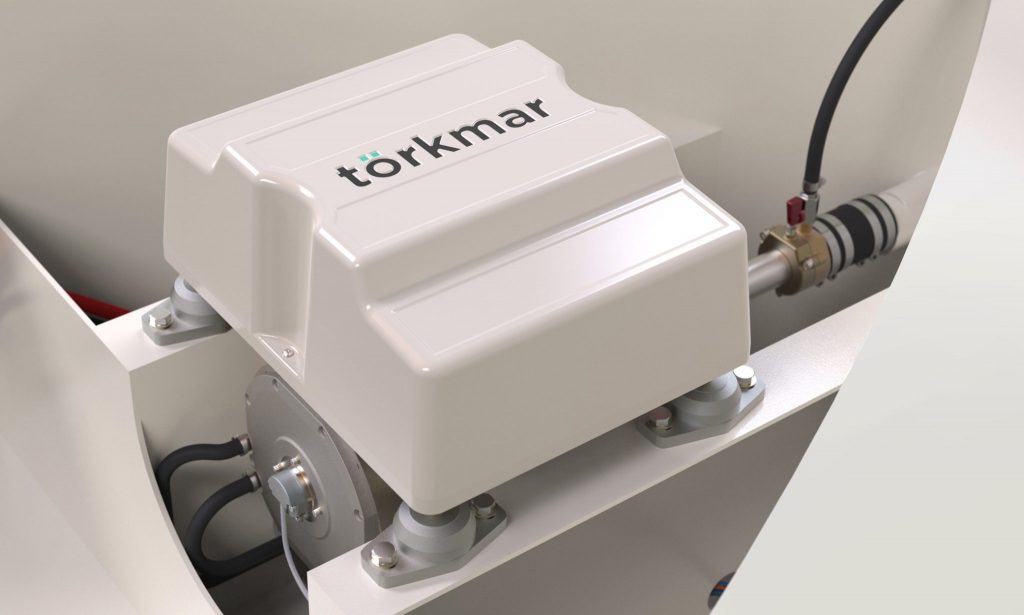
Meet the Torkmar Tidal
The motor in the diagram above shares its key numbers with the 15kW Torkmar Tidal: 48 volts, 8 poles and a nominal speed of 1,000 rpm. The Tidal is our award-winning PMAC motor for narrowboats, widebeams and other displacement boats.
It has the highest torque rating in its class, with 245 Nm instant and 143 Nm rated. That torque lets it turn a large propeller slowly and efficiently, which is exactly what a heavy hull needs at canal speeds, and it gets more range from every charge. It runs near-silently, with no engine rumble or hull vibration. And because the rotor and its two bearings are the only moving parts, there’s no oil, filters or belts to change.
The Tidal suits new builds and engine retrofits alike.